


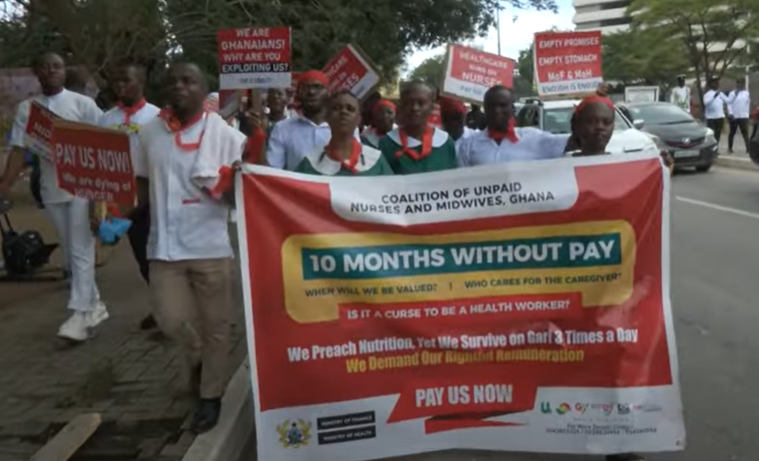
On Thursday, October 2, the Coalition of Unpaid Nurses and Midwives held a demonstration in Accra to press for the release of salaries owed to nearly 7,000 health professionals who have worked for close to 10 months without pay.
The protest began at Efua Sutherland Children’s Park, after which the demonstrators marched through the city and later converged at the Ministry of Finance and the Ministry of Health, where they submitted petitions.
According to the group, they were officially posted in December 2024 following financial clearance. While about 6,500 of their colleagues received payment in April 2025, thousands are still waiting for their wages despite repeated appeals.
The convener of the coalition, Stephen Kwadwo Takyiah, described the prolonged delay as unacceptable and disheartening.
“Although some 6,500 colleagues have been paid since April 2025, the continued withholding of salaries for the rest is undermining the delivery of quality healthcare nationwide,” he stated.
Mr. Takyiah shared distressing accounts of how the situation has affected health workers.
“One colleague recently underwent surgery, yet we are struggling to cover her hospital expenses. Another, who suffers from asthma, spends about GH¢300 monthly on inhalers, purchasing them three times a month. Our members are in pain, some are even dying, yet we have served faithfully,” he lamented.
He further emphasized the wider consequences for Ghana’s health sector, warning that the delays are not only unfair but also a threat to the nation’s healthcare system.
Quoting President John Dramani Mahama’s remarks at the recent UN General Assembly, Mr. Takyiah drew a sharp comparison.
“The President said slavery is the greatest crime against humanity. Today, I say this is modern-day slavery. To deny health workers their rightful salaries is one of the gravest injustices any leader can commit. We are begging the government to act immediately—otherwise, we are perishing, and our healthcare system is collapsing,” he declared.
Another nurse narrated his daily struggle to survive.
“Most days I wait until 2 p.m. before I can afford to eat ‘gob3,’ and then I drink water until the next day. Sometimes I eat only once, and on some days, not at all,” he revealed.
The demonstration underscores a recurring challenge in Ghana’s public sector, where newly recruited workers—especially in health and education—often endure long delays before receiving their first salaries.
For the nurses and midwives, Thursday’s protest was not only about unpaid wages but also about dignity, survival, and the sustainability of Ghana’s healthcare system.
By taking to the streets, they delivered a strong message to both the government and the public: health professionals, who are vital to saving lives, deserve fairness and timely payment.
Leave a Reply