


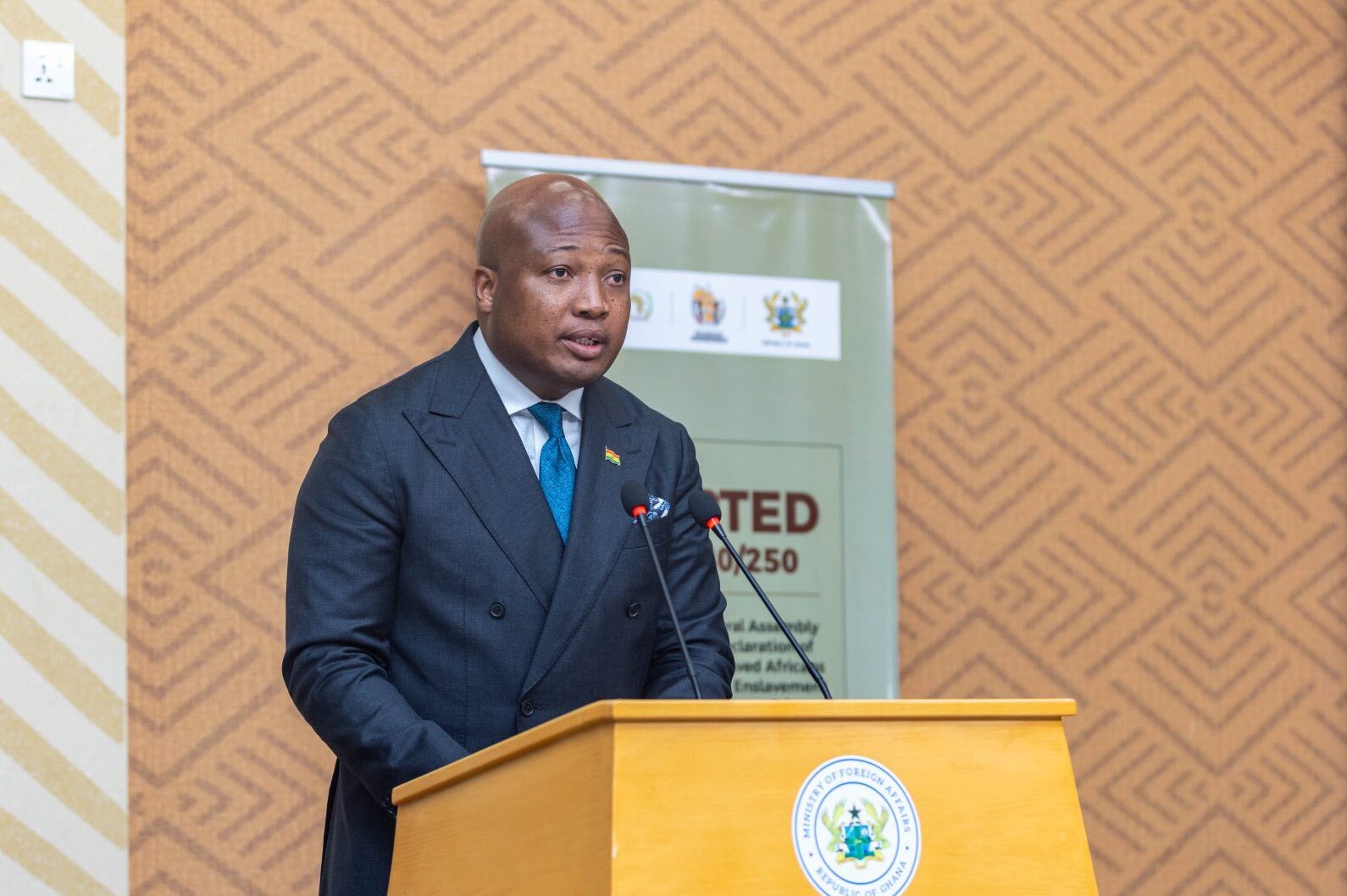
Ghana’s Minister for Foreign Affairs, Honourable Samuel Okudzeto Ablakwa (MP), has described the adoption of a historic United Nations General Assembly resolution declaring the trafficking of enslaved Africans and racialised chattel enslavement of Africans as the gravest crime against humanity as a turning point in global justice.
Briefing the press in Accra, Hon. Ablakwa explained that Resolution A/RES/80/250, championed by President John Dramani Mahama in his capacity as African Union Champion on Reparations, was adopted on March 25, 2026 — the International Day of Remembrance of the Victims of Slavery and the Transatlantic Slave Trade. The resolution passed with 123 votes in favour, 3 against, and 52 abstentions.
The Minister stressed that the resolution marks a shift from mere commemoration to acknowledgment of the structural consequences of the transatlantic slave trade and the urgent need to advance reparatory justice. He rejected narratives portraying slavery as a trading system involving Africa, clarifying that what transpired was organised human trafficking and exploitation driven by external demand, financed through transcontinental networks, and codified by legal regimes outside Africa.
Hon. Ablakwa emphasised that reparatory justice is not about direct payments to leaders but about addressing enduring consequences of historical injustices through education, infrastructure development, and community support. He noted that while no compensation can fully account for the atrocities, the resolution provides a framework for dialogue on compensation, institutional reforms, education, research, and cultural restitution.
He expressed profound gratitude to the African Union, CARICOM, CELAC, and the 123 UN Member States who supported the resolution, as well as international partners including the Congressional Black Caucus, NAACP, Pan-African Lawyers Union, Rev. Al Sharpton, Ben Crump, and leading academics and activists whose collaboration built the global coalition behind the adoption.
This landmark resolution, he concluded, strengthens the moral and legal foundation for advancing reparatory justice and ensuring that the voices of Africans and people of African descent are heard in shaping a more just global order.