


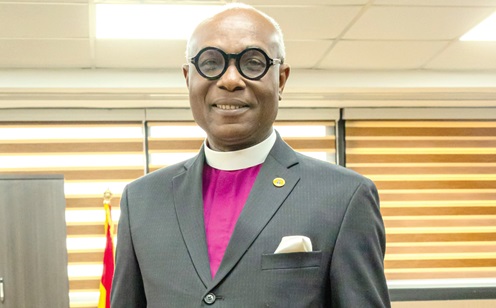
The Methodist Church Ghana has reacted to reports of a lawsuit filed at the Supreme Court against Wesley Girls’ High School (WGHS), stating it is working to secure the official court papers and will vigorously protect its interests.
In a statement released on Friday, November 28, and signed by the Presiding Bishop, Most Rev. Prof. Johnson K. Asamoah-Gyadu, the Church said it had been alerted “through the media to a pending suit in the Supreme Court intituled Shafic Osman v. The Board of Governors, Attorney-General & Ghana Education Service.”
Although the Church has not yet been formally served, it indicated that steps are being taken to quickly obtain the records.
“We are taking steps to obtain the official records of all proceedings… to enable our legal team to take the necessary action to protect the Church’s interests.”
Addressing public claims that WGHS discriminates against students of other religions, the Church categorically denied the charge.
“It is important to restate the position of the Methodist Church of Ghana regarding the unfortunate allegation that WGHS, as a government-assisted school, is a ‘public school’ engaging in discriminatory practices against students of other faiths.”
The Church highlighted that Wesley Girls’ High School, established in 1836 by Harriet Wrigley, has consistently promoted inclusivity in education. For nearly two centuries, the school has trained students from varied religious and cultural backgrounds.
WGHS, the statement noted, has educated students from “Methodists, Adventists, Jehovah’s Witnesses, Muslims, Eckists, Buddhists, Hindus, Atheists, Agnostics, Catholics, Anglicans, Presbyterians, Pentecostals and many others who have gone on to contribute meaningfully to society.”
The release stressed that discrimination is “fundamentally inconsistent” with Methodist principles. As the Church affirmed, “The Methodist Church Ghana considers discrimination to be fundamentally inconsistent with Christian teaching, and therefore incompatible with our mission.”
It reminded the public that government assistance to mission schools since the early 1960s has never altered their identity. WGHS, it said, continues to operate within its Methodist ethos, as guaranteed by the 1992 Constitution.
Students, the Church explained, are only expected to respect the school’s long-standing traditions. “All that the school requires of admitted students is respect for its traditions and adherence to an established framework… designed to foster unity, discipline, academic excellence, uniformity and shared experience.”
The statement cautioned that creating separate systems for students of different faiths would weaken the school’s unity.
“To create a parallel system where some students of different faith groups eat, sleep, wake, study and live separately would inevitably lead to segregation and undermine the cohesion and collective traditions of the school.”
The Church also referenced the Memorandum of Understanding signed on April 15, 2024, by the Conference of Managers of Education Units (COMEU) with facilitation from the National Peace Council. The MOU, developed with input from major Christian and Muslim groups, provides guidelines for peaceful coexistence in mission schools.
The Methodist Church said it had “fully adhered” to the agreement and expressed gratitude to the Ghana Catholic Bishops’ Conference, the Christian Council of Ghana, and the Anglican Church for their public support.
Reaffirming its values, the Church declared its “treasured Wesleyan heritage admits of no discrimination whatsoever,” adding that it has always shown “respect for other traditions and faiths.”
Finally, the Church assured the public of its dedication to peace and cooperation. “The Methodist Church Ghana remains committed to dialogue and collaboration with all relevant stakeholders to ensure peace, understanding, and mutual respect among all faiths and traditions.”
Leave a Reply