


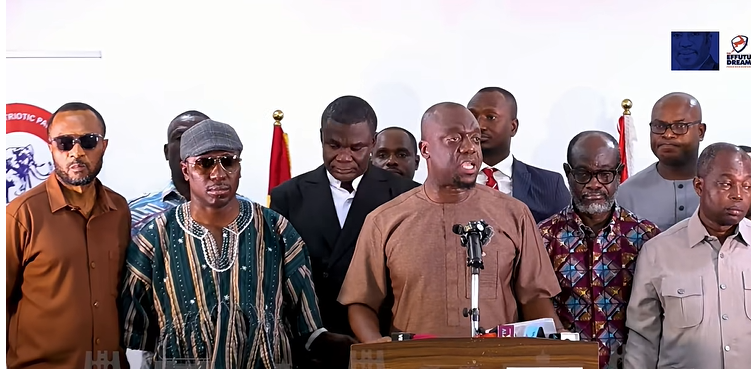
The Parliamentary Minority Caucus has issued a strongly worded statement questioning the legitimacy of the High Court ruling that convicted Bernard Antwi‑Boasiako, popularly known as Chairman Wontumi, alongside Akonta Mining Limited under the Minerals and Mining Act, 2006 (Act 703).
The judgment, delivered by Justice Audrey Kocuvie‑Tay in Accra, imposed a twenty‑year custodial sentence on the Ashanti Regional Chairman of the New Patriotic Party (NPP). The Minority Caucus described the ruling as “seriously defective,” citing the denial of counsel of choice and the refusal to refer constitutional questions to the Supreme Court.
In its release, the Caucus expressed solidarity with Wontumi’s family and the NPP membership, acknowledging the grief and anger stirred by the ruling. “The best tribute we can pay to Chairman Wontumi and his family right now is resolve, channelled through every lawful and constitutional means available to us,” the statement read.
While pledging to pursue justice through Parliament and public advocacy, the Minority underscored its respect for judicial institutions. It stressed that criticism of legal reasoning should not be mistaken for attacks on judicial integrity. “To criticise a judgment on its legal reasoning is not to attack the judiciary; it is to participate in the very culture of legal accountability that a mature democracy requires,” the Caucus noted.
The statement further raised concerns about the trial court’s decision to pierce the corporate veil of Akonta Mining Limited, holding Wontumi personally liable for alleged corporate acts. The Minority called for scrutiny of the legal basis for this principle, warning of its implications for corporate governance and constitutional order.
The Caucus reaffirmed its commitment to defending judicial independence under Articles 125 and 127 of the 1992 Constitution, while insisting that the judgment must be tested against constitutional safeguards. It vowed to continue pressing for redress until what it described as “defects that robbed this judgment of legitimacy” are corrected.