


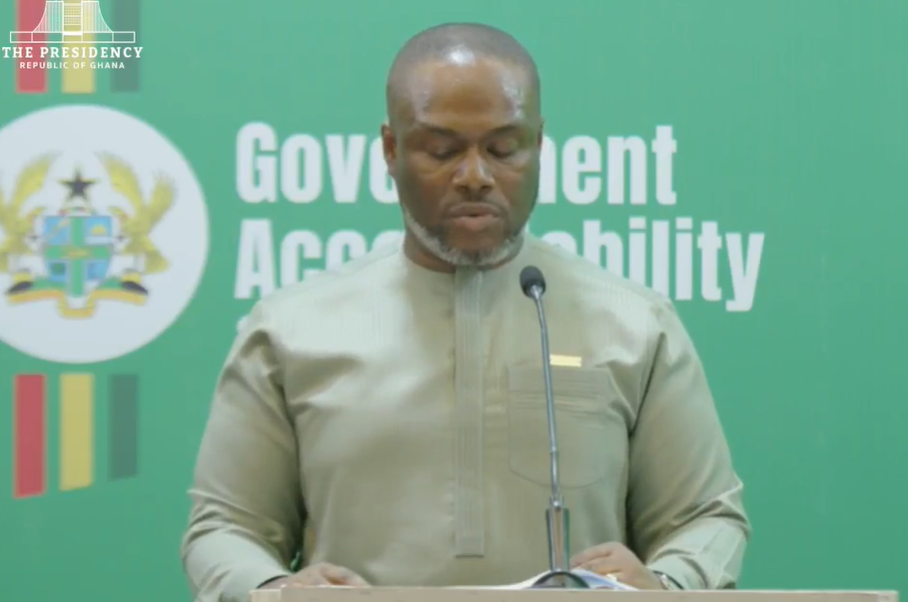
The Minister for Works and Housing, Kenneth Gilbert Adjei, has revealed that although a majority of Ghanaians have access to basic water services, fewer than half of the population benefit from safely managed sources.
Citing data from the Ghana Statistical Service (GSS) and the WHO/UNICEF Joint Monitoring Programme (JMP), Mr. Adjei noted that about 88 percent of the population currently enjoys basic water services. However, less than half have access to water that meets the standard of safety and reliability.
“Only 44% per cent of the population benefits from safely managed water services, defined as an improved water source that is on-premises, available when needed and free from contamination,” Mr Adjei stated during the Government Accountability Series in Accra on Wednesday, January 28, 2026.
While the overall figures may appear encouraging, the minister stressed that disparities remain stark between urban and rural communities. He explained that urban water access stands at about 96 percent, compared to an average of 74 percent in rural areas.
“Certain regions are experiencing access rates as low as 42%. It is important to note that these figures include communities where service is often intermittent and unreliable,” he added.
Mr. Adjei also drew attention to challenges facing urban water delivery, particularly the high levels of non-revenue water, which he estimated at 50 percent—twice the international benchmark of 25 percent.
“One of the critical challenges facing urban water supply is non-revenue water, which stands at an estimated 50%,” he said, cautioning that the situation continues to undermine efficiency and financial sustainability in the sector.
He further disclosed that nearly four million Ghanaians still depend on unimproved, limited, or surface water sources, exposing them to serious health and environmental risks.
The minister attributed the sector’s difficulties to a mix of structural and environmental factors, including aging infrastructure, inadequate investment in maintenance, weak cost recovery systems, high operational expenses, pollution of water bodies, and climate-related variability.
Mr. Adjei assured that government remains committed to tackling these challenges through targeted investments, reforms, and stronger collaboration with development partners to expand access to safe, reliable, and sustainable water services nationwide.
Leave a Reply