


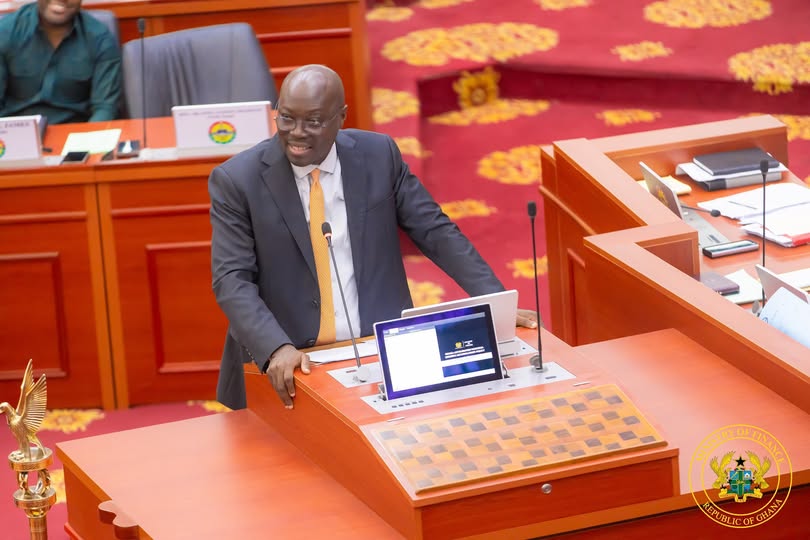
Ghana’s government has announced a bold new policy aimed at strengthening the nation’s economic resilience, following what officials describe as a decisive turnaround in macroeconomic performance over the past year.
Presenting the statement before Parliament, the Minister highlighted that Ghana’s economy rebounded strongly in 2025 after the turbulence of the 2022–2023 crisis. Key indicators underscored the recovery: real GDP growth averaged 6.1% in the first three quarters of 2025, inflation fell from 23.8% in 2024 to 3.8% in January 2026, and interest rates dropped sharply, with the 91-day Treasury bill declining from 27.7% at the end of 2024 to 6.4% in February 2026.
Fiscal and external balances also improved significantly. The primary balance shifted from a deficit of 3.0% in 2024 to a surplus of 2.6% of GDP, while public debt fell from 61.8% to 45.3% of GDP. The current account recorded a surplus of US$9.1 billion, up from US$1.5 billion the previous year. Meanwhile, the cedi appreciated markedly against major currencies, and gross international reserves rose to US$13.8 billion, covering 5.7 months of imports.
Despite these gains, the Minister cautioned that the current reserve levels, though above the traditional benchmark of three months of import cover, remain insufficient to shield the economy from disruptive shocks. “We must ensure that Ghana never again experiences the kind of destabilizing depreciation witnessed in 2022–2023,” he told lawmakers.
To that end, Cabinet has approved the Ghana Accelerated National Reserve Accumulation Policy (GANRAP). The initiative sets a target of raising reserves to the equivalent of 15 months of import cover by the end of 2028. Anchored on the Ghana Gold Board Act, 2025 (Act 1140), the policy leverages gold exports and reserve accumulation by the Bank of Ghana as a cornerstone of external resilience.
Officials say GANRAP is informed by lessons from past downturns, current macroeconomic trends, global risk assessments, and Ghana’s long-term transformation agenda. The policy is expected to provide a stronger buffer against external shocks, stabilize the currency, and reinforce investor confidence.
As Ghana enters this new phase of economic management, the government’s challenge will be sustaining growth while building the reserves needed to secure lasting stability.
Leave a Reply