


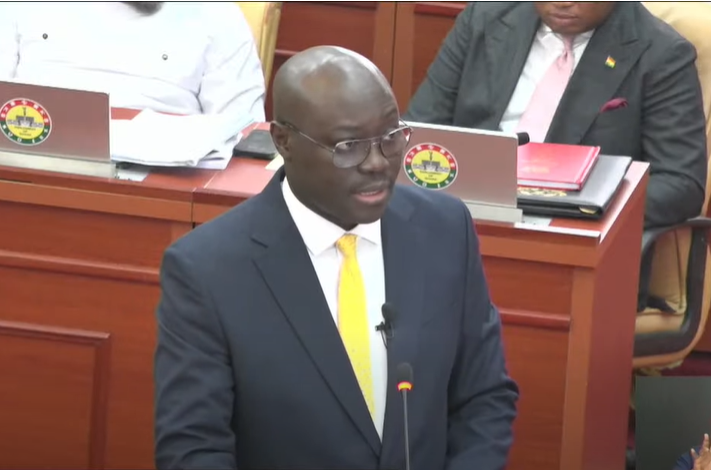
Finance Minister Dr. Cassiel Ato Forson has forcefully pushed back against accusations that the government is neglecting crucial areas of public spending.
Delivering the 2025 Mid-Year Fiscal Policy Review to Parliament on Wednesday, July 24, Dr. Forson stated emphatically, “Contrary to the perception that we are not spending, we are indeed spending and spending at the right places.”
His comments were a direct rebuttal to what he termed a “false narrative” suggesting government inaction or misaligned priorities.
“We are making the right investments,” he affirmed, before presenting a comprehensive breakdown of expenditures across vital sectors of the economy.
To silence doubters, Dr. Forson unveiled a detailed list of financial disbursements made between January and June 2025.
Leading the list was a US$700 million Eurobond repayment, which he cited as proof of Ghana’s renewed commitment to its international financial responsibilities.
But that was only the beginning.
“We have paid GH¢10 billion to domestic bondholders,” he noted, underscoring the administration’s resolve to rebuild trust in the local debt market.
He then spotlighted what he described as “strategic investments in essential services”:
- GH¢2.9 billion to the District Assemblies Common Fund (DACF)
- GH¢2.7 billion to SSNIT to secure pension payments
- GH¢9.1 billion to the energy sector to ensure reliable power supply
- GH¢5 billion to settle outstanding arrears
- GH¢4.6 billion to the Ghana Education Trust Fund (GETFund)
Education, healthcare, and social welfare were also central to his list of “high-impact spending.”
“We’ve paid GH¢1 billion to sustain free secondary education, GH¢4.6 billion to the National Health Insurance Scheme, and another GH¢1.4 billion to clear NHIS claims,” he announced.Additional allocations included GH¢252 million for vaccines and essential medicines,GH¢72.8 million for the Capitation Grant, GH¢895 million to keep the School Feeding Programme operational
“We are not neglecting the vulnerable,” he asserted, citing GH¢477 million disbursed to LEAP beneficiaries,GH¢300 million for the No Fee Stress Policy,GH¢122.8 million for BECE registration andGH¢654 million combined support for teacher and nursing trainees
Dr. Forson also revealed that GH¢25 million paid in allowances to Assembly Members , GH¢21 million to the National Apprenticeship Programme and GH¢34.5 million to fund the Adwumawura Programme, aimed at job creation and enterprise development
To ensure smooth functioning of government institutions, he disclosed that GH¢2 billion had been allocated to sustain operations of Ministries, Departments, and Agencies and Another GH¢2 billion was used to stabilize the National Investment Bank (NIB)
“This is not arbitrary spending. These are intentional, focused measures to protect the vulnerable, invest in human development, and uphold economic resilience,” Dr. Forson emphasized.
Wrapping up, he reported that non-interest expenditures totaled GH¢84.2 billion, while overall disbursements from the Consolidated Fund in the first half of 2025 reached GH¢114.5 billion.
“We are not asleep at the wheel. We are working with focus, responsibility, and urgency—to reset this economy for the Ghana we want,” he concluded, reinforcing the central message of the mid-year review.
As Parliament begins its detailed examination of the figures, Dr. Forson’s stance remains firm: the government isn’t just spending—it’s investing where it matters most.
Leave a Reply