


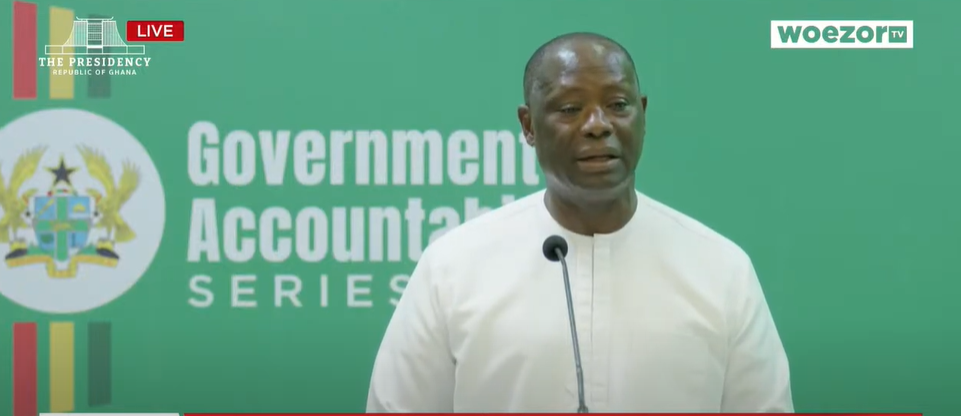
The Minister for Lands and Natural Resources, Hon. Emmanuel Armah-Kofi Buah, has reaffirmed the government’s unwavering commitment to eradicating illegal mining, acknowledging the complexity of the issue but stressing that it can be overcome.
Speaking at the Government Accountability Series in Accra on Wednesday, the Minister conceded that tackling galamsey is a tough challenge, yet he reassured citizens: “We will definitely prevail.”
“This is a marathon, not a sprint,” he emphasized. “With the political backing of H.E. President John Dramani Mahama, we are determined to restore our rivers, revive our forests, and protect our environment for future generations.”
Hon. Buah announced a comprehensive overhaul of Ghana’s mining legislation to address longstanding inequities and ensure fair returns for all citizens. The review of the Minerals and Mining Act, 2006 (Act 703), and the 2014 Mining Policy is 85% complete.
Key changes include:
- Shortening the duration of mining and prospecting licenses
- Ending automatic renewals when conditions aren’t met
- Introducing a new license category for medium-scale mining
- Mandating Community Development Agreements with revenue-sharing
- Eliminating Development Agreements and restricting stability clauses to essential long-term projects
“We’re not anti-mining,” the Minister clarified, “but we insist that mining be done responsibly and sustainably.”
Demonstrating resolve, Hon. Buah disclosed that 55 small-scale mining licenses issued during the previous transition period have been revoked. Another 907 licenses are under scrutiny for possible cancellation due to irregularities.
Security operations have resulted in: 425 excavators seized1,345 individuals arrested
Hundreds of other machines confiscated, including bulldozers, changfangs, and pumps
In forest reserves alone, 177 excavators were impounded and 286 illegal miners apprehended.
To streamline enforcement, the Ministry has launched the National Anti-Illegal Mining Operations Secretariat (NAIMOS) a centralized unit combining legal, environmental, and security efforts.
A new digital system is being piloted to monitor heavy mining machinery. Hon. Buah revealed that over 191 excavators are now tracked in real-time via the Ghana Mine Repository and Tracking Software.
In collaboration with Customs and the Transport Ministry, over 1,200 excavators imported into Ghana are being verified before release from Tema Port, in line with L.I. 2404, which mandates registration and GPS tracking of all mining equipment.
To combat water pollution from illegal mining, 450 Blue Water Guards have been trained and deployed. Another 530 are set to graduate by July 25, aiming for a total of 2,000 by year’s end.
“These guards are non-confrontational,” the Minister explained. “They act as intelligence agents, raising awareness and working within communities to protect our rivers.”
Phase two of the initiative will focus on detoxifying polluted water bodies and restoring their ecosystems.
Illegal mining and logging have ravaged over 5,500 hectares of forest reserves. The Forestry Commission has reclaimed all nine red-zoned reserves previously occupied by illegal miners.
The government’s Tree for Life campaign aims to plant 30 million trees. So far, 7.6 million have been planted, with more underway during the rainy season.
Private proposals are being considered to transform reserves like Digya National Park and Shai Hills into eco-tourism destinations.
Under President Mahama’s Reset Ghana Agenda, the Lands Commission is decentralizing services to 90 districts, aiming for a 30-day turnaround on land applications. A new Enterprise Land Information System (ELIS) will digitize land records and reduce fraud.
A legislative instrument to enforce the Land Act, 2020 (Act 1036), is nearing completion, and a full audit of public land allocations is expected by August 2025.
The Ghana Geological Survey Authority (GGSA) is supplying data to small-scale miners and has ruled out imminent seismic threats. Studies on geothermal energy and clay deposits are underway to support clean energy and industrial growth.
The Ghana Integrated Iron and Steel Development Corporation (GIISDEC) is regulating the scrap metal industry and has issued three licenses for the Sheini Iron Ore Project. High-grade reserves have been confirmed at Gyamurume, Bodada Block II, and Pudo.
Meanwhile, GIADEC has secured six bauxite leases pending parliamentary approval, with plans for rail expansion, upgrades to Takoradi Port, and support for VALCO’s revival.
In closing, Hon. Buah called on all Ghanaians, traditional leaders, and civil society to unite in protecting the nation’s natural wealth:
“We have drawn a line in the sand,” he declared. “We will fight against irresponsible and reckless mining in any form. This is a fight for the soul of our country.”
Leave a Reply