


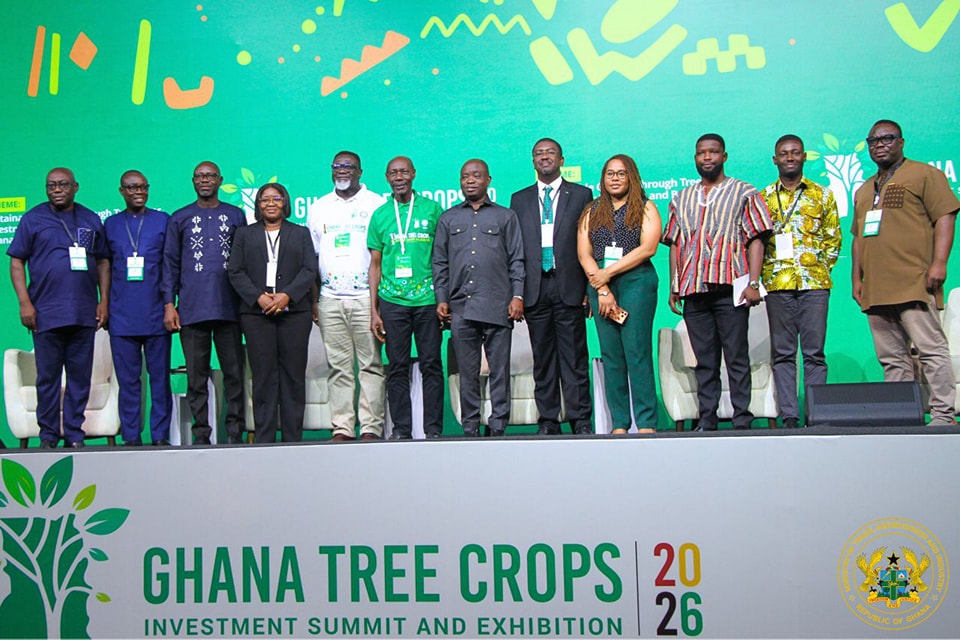
The Deputy Minister for Trade, Agribusiness and Industry, Hon. Sampson Ahi, has called on investors to scale up private sector participation in Ghana’s tree crop industry, describing it as one of Africa’s most compelling agribusiness opportunities.
Speaking at the maiden Ghana Tree Crops Investment Summit & Exhibition (GTCIS–2026), Hon. Ahi emphasized that the sector is undergoing a transformation from a traditional raw commodity exporter to a value-driven industrial powerhouse.
“Ghana’s tree crops are no longer just about exporting raw produce. The time to invest is now,” he charged, highlighting the industry’s focus on value addition, industrial expansion, and capturing a greater share of the $300 billion global processed commodities market.
The Deputy Minister noted that while Ghana already earns billions in export revenue from cocoa, rubber, cashew, shea, oil palm, and coconut, the true opportunity lies in expanding local processing capacity. He cited bold policy reforms such as the ban on raw rubber lump exports and the government’s 50 percent local cocoa processing target as measures designed to de-risk private sector investments and make ventures more bankable.
He further referenced the “Feed the Industry” programme, which aggregates production from more than two million farmers through cooperatives and out-grower schemes. This system, he explained, ensures traceability, sustainability compliance, and reliable supply—critical requirements for premium export markets in Europe and North America.
Hon. Ahi also pointed to Ghana’s political stability, strong legal framework, efficient port infrastructure, and youthful workforce as competitive advantages. As host of the African Continental Free Trade Area Secretariat, Ghana offers investors strategic access to a continental market of 1.3 billion people.
He assured participants that the Ministry’s agribusiness unit is ready to fast-track permits, facilitate land acquisition, connect investors to farmer cooperatives, and support financing discussions to move projects from agreement to groundbreaking within six months.
Representatives from financial institutions pledged their support to unlock financing for the tree crop sector, aiming to ease constraints, enhance competitiveness, and reduce the financial burden on farmers.
The summit concluded with a shared commitment from government, industry stakeholders, and development partners to position Ghana as a reliable hub for tree crop processing and exports in West Africa.
Leave a Reply