


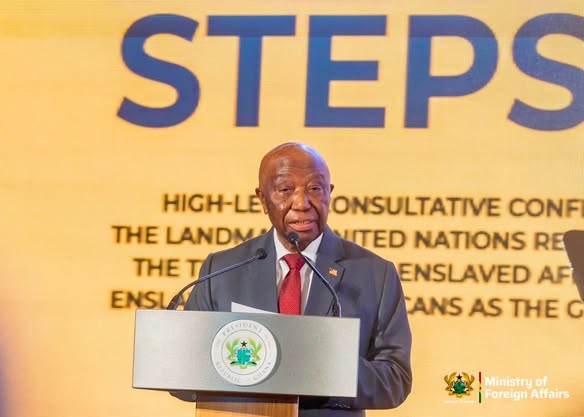
The President of the Republic of Liberia, His Excellency Joseph Nyuma Boakai Sr., joined fellow Heads of State and Government in Accra for the High-Level Consultative Conference on Next Steps to the Landmark UN Resolution on the Trafficking of Enslaved Africans. The three-day conference, held from June 17–19, 2026, focused on advancing reparatory justice in response to the enduring consequences of the transatlantic slave trade.
In his address, President Boakai underscored the significance of the adoption of UN Resolution A/RES/80/250, describing it as a historic step in acknowledging the grave injustices of racialized chattel enslavement. He emphasized that the legacy of slavery continues to shape societies, noting that in Liberia, questions of identity remain deeply intertwined with this painful history.
“The impact of transatlantic enslavement extends beyond economic loss to include lasting social, cultural, and political consequences that have persisted across generations,” President Boakai stated.
He stressed that meaningful reparatory justice must encompass historical truth-telling, reconciliation, cultural restoration, education, and efforts to strengthen social cohesion.
Recommendations for the Way Forward
President Boakai outlined several proposals to guide the global pursuit of reparatory justice:
- Common framework — Establishing a unified roadmap for nations to pursue reparatory justice.
- African-led UN Expert Commission — Designing a global mechanism to address reparatory justice.
- Education and research — Strengthening awareness of African history and the transatlantic slave trade.
- Restitution of cultural artifacts — Promoting the return of heritage items taken during slavery and colonialism.
- Development partnerships — Advancing initiatives to tackle inequalities rooted in slavery, colonialism, and exploitation.
He called on the international community to engage honestly with this dark chapter of history and support efforts aimed at healing and repair.
“The pursuit of reparatory justice is about acknowledging historical injustices, fostering understanding, and building a future based on dignity, equality, and shared responsibility,” he affirmed.
President Boakai expressed optimism that collective commitment and cooperation among nations would restore dignity, address historical wrongs, and create a more equitable future for generations to come.
Leave a Reply