


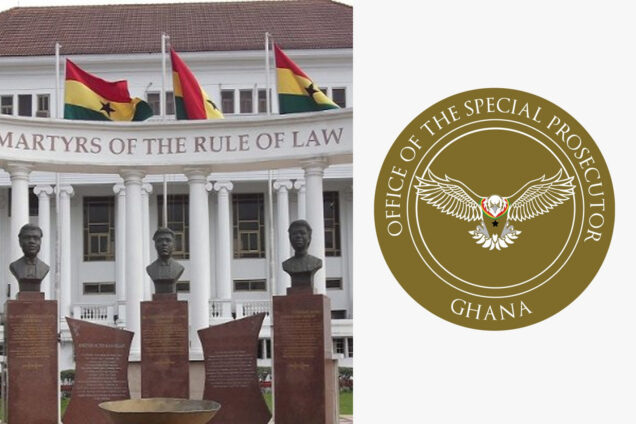
The Supreme Court is expected to deliver a landmark judgment on July 29, 2026, in a constitutional case brought by private citizen and lawyer Noah Ephraem Tetteh Adamtey, which questions the legality of the prosecutorial powers exercised by the Office of the Special Prosecutor (OSP).
The case has attracted significant public and legal interest because its outcome could have far-reaching implications for Ghana’s anti-corruption architecture and the future operations of the OSP.
Mr Adamtey is asking the apex court to determine whether Parliament acted within its constitutional mandate when it enacted the Office of the Special Prosecutor Act, 2017 (Act 959) and granted the OSP independent investigative and prosecutorial powers.
Core of the challenge
The suit, filed under Supreme Court case number J1/3/2026, argues that the 1992 Constitution vests prosecutorial authority exclusively in the Attorney-General under Articles 88(3) and 88(4).
According to Mr Adamtey, Parliament lacks the authority to establish a prosecutorial body that operates independently of the Attorney-General and outside the Attorney-General’s constitutional supervision. He is therefore seeking orders striking down portions of Act 959 that confer autonomous prosecutorial powers on the OSP or shield the institution from the Attorney-General’s control.
The lawsuit specifically targets provisions of the law that establish the OSP’s independence and grant it powers to investigate, search for, seize and recover suspected tainted property linked to corruption and corruption-related offences.
Earlier Supreme Court ruling
The case has already produced a significant preliminary ruling.
In January this year, the Supreme Court unanimously dismissed an application by the OSP seeking to be joined as a party to the proceedings.
The OSP had argued that because the suit directly challenges its statutory powers, particularly Sections 4 and 33 of Act 959, it should be allowed to participate in the case. However, the court ruled that the constitutional issues could be adequately determined between the plaintiff and the Attorney-General without the OSP’s direct involvement.
The court consequently held that the Attorney-General remains the sole defendant in the action.
Civil society organisations joined to case
In a significant development however, the Supreme Court granted an application by 14 Civil Society Organisations (CSOs) seeking to join the proceedings.
The organisations argued that they played instrumental roles in the establishment of the OSP and could assist the court in determining the constitutional questions raised in the suit. They further maintained that the outcome of the case could have major implications for Ghana’s anti-corruption architecture and broader governance framework.
The CSOs admitted to the case include the Ghana Centre for Democratic Development, Transparency International, IMANI Africa, One Ghana Movement, Africa Centre for Energy Policy, STAR-Ghana Foundation, Odikro and Parliamentary Network Africa, among others.
The Attorney-General did not oppose the application, and the Supreme Court subsequently granted the organisations leave to file their submissions.
Why the judgment matters
The decision expected on July 29 is being closely watched because it could determine the constitutional status of one of Ghana’s most prominent anti-corruption institutions.
Established under Act 959 and operational since 2018, the OSP was created to investigate and prosecute corruption and corruption-related offences, particularly cases involving politically exposed persons and public officials. The institution was designed to function independently in order to strengthen the fight against corruption and avoid potential conflicts associated with the Attorney-General’s dual role as a political appointee and chief prosecutor of the state.
Should the Supreme Court uphold Mr Adamtey’s arguments, key provisions underpinning the OSP’s independence and prosecutorial authority could be affected. Conversely, a ruling in favour of the Attorney-General would reinforce the legal foundation of the OSP and affirm Parliament’s authority to establish specialised prosecutorial bodies.
The judgment is therefore expected to clarify important constitutional questions regarding the separation of powers, prosecutorial authority and the legal framework governing Ghana’s anti-corruption regime.
Source: Myjoyonline
Leave a Reply