


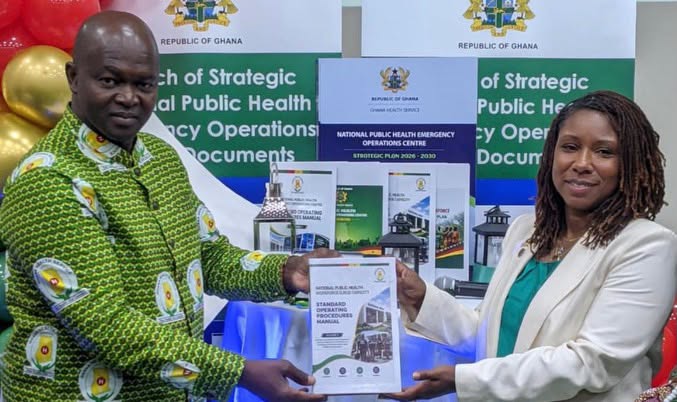
The Ghana Health Service has launched a suite of strategic documents and a national roadmap to guide the establishment, governance and phased operationalization of Public Health Emergency Operations Centres (PHEOCs) across the country, in a move aimed at strengthening Ghana’s capacity to prepare for, coordinate and respond to public health emergencies. The launch, held at the Prof. Agyeman Badu Akosa Conference Centre of the new GHS Headquarters in Pantang, brought together stakeholders from the health and non-health sectors to advance a well-coordinated and effective national public health emergency management system.
In his welcome address, delivered on behalf of the Director of the Public Health Division, Dr. Kwame Amponsa Achiano, Deputy Director for Disease Control, emphasized that managing modern public health crises required an all-inclusive, multi-sectoral approach. He stated that modern emergencies ranging from infectious disease outbreaks and floods to chemical hazards and points-of-entry threats extend beyond health sector boundaries to impact national security, trade, transportation, and the broader economy. Emphasizing that public health emergency preparedness demands connected leadership, timely information sharing, clear accountability, and collective action, Dr. Amponsa-Achiano highlighted that the newly unveiled policy suite establishes a standardized blueprint for governance and coordination, with the primary focus now shifting from preparedness on paper to functional readiness in practice.
Delivering the keynote address and officially launching the documents, the Director General of the Ghana Health Service commended the entire PHEOC team for more than eight years of dedicated work towards developing and operationalizing the national PHEOC framework. Drawing lessons from past health emergencies, including the 2014 West African Ebola outbreak and the COVID 19 pandemic, the Director General stressed that the effectiveness of Ghana’s response to public health threats depends not only on having well developed plans, but on the ability of institutions to act as one coordinated system when emergencies arise.
To sustain inter agency collaboration and ensure continued readiness, he proposed the establishment of an annual “National Public Health Emergency Operations Centre Day” to test preparedness, review response protocols and strengthen coordination among national emergency response and security partners.
Providing a detailed technical overview of the framework, Dr. Lawrence Lartey, Head of the National Public Health Emergency Operations Centre (PHEOC), outlined the roadmap for moving from strategic frameworks to functional emergency coordination. He presented the five core strategic documents being launched under one integrated system, beginning with The National PHEOC Strategic Plan (2026–2030), which establishes the overarching national direction, priority investment areas, and the five-year operational implementation roadmap for emergency response infrastructure. This is complemented by The National PHEOC Handbook (2026), which defines how the emergency system is organized and functions across governance, Incident Management Systems (IMS), coordination, and public health information management. To guide practical execution, The National PHEOC Standard Operating Procedures (SOPs) – Volume 1 provides actionable operational guidelines focusing on system activation, incident management execution, escalation, de-escalation, and deactivation protocols during a crisis. Addressing human resource requirements, The National Public Health Workforce Surge Strategic Plan (2026) sets out the strategic framework to rapidly build, train, and maintain human resource surge capacity with an emphasis on preparedness, competence, and sustainability, while The National Public Health Workforce Surge Management SOPs – Volume 2 serves as a practical compendium of four detailed SOPs governing the management of the surge roster, activation mechanisms, personnel deployment procedures, and post-response reintegration.
Dr. Lartey noted that these documents align with international benchmarks, supporting Ghana’s implementation of the International Health Regulations (IHR 2005), addressing priority recommendations from the Joint External Evaluation (JEE), and advancing the National Action Plan for Health Security (NAPHS). He further detailed the seven core strategic priority areas guiding the five-year plan which include governance, ICT and public health intelligence (leveraging AI and predictive modeling), logistics and infrastructure, emergency operations and Incident Management Systems (IMS), workforce surge capacity, and sustainable financing. Reaffirming that the launch represents a crucial transition from documents to action, he stressed that true success will be measured by moving from episodic preparedness to continuous, operational readiness across the country.
Delivering solidarity remarks, the Country Director of KOICA Ghana, Dong Wan Woo, reaffirmed the Republic of Korea’s commitment to Ghana’s public health sector. Expressing his gratitude to the Ghana Health Service, US CDC, WHO, AFENET, and other multilateral partners, Mr. Woo emphasized that effective emergency preparedness is a shared responsibility requiring broad, multi-sectoral collaboration across government, security agencies, academia, and civil society. He described the launch as a pivotal beginning of a new phase focused on sustained implementation and coordination on the ground, pledging KOICA’s continued support to translate the strategic roadmap into resilient health systems and enhanced global health security.
Delivering a key address on behalf of the US Centers for Disease Control and Prevention (US CDC), the outgoing Country Director, Dr. Danielle T. Barradas, expressed deep personal satisfaction in witnessing the launch, noting that the journey began five years ago when she first arrived in Ghana. Reflecting on the iterative process of drafting, consulting, and revising, Dr. Barradas highlighted that during these years, Ghana’s public health emergency management system was repeatedly tested by real-world events, including COVID-19, Marburg virus, Mpox, Lassa fever, polio, and numerous other outbreaks.
She noted that these real-time experiences provided invaluable lessons on what works and where gaps exist, directly shaping the strategic documents being launched to ensure a move from reliance on individual memory to institutionalized, repeatable, and testable systems. Reaffirming the US CDC’s pride in supporting the development of the PHEOC Handbook and the Workforce Surge Strategic Plan alongside AFENET and the GHS team, Dr. Barradas emphasized that health security is fundamentally about people, relationships, and teamwork. She cautioned that launching the documents is only the first step, urging stakeholders to train personnel, run simulation exercises, and utilize the framework during live events to build a truly resilient, decisive emergency response capacity that contributes to both national and global health security.
Expressing her gratitude to GHS leadership, the Public Health Division, the Disease Surveillance Department, CDC Fellows, and multilateral partners, she shared her profound personal appreciation for seeing this foundational vision realized before her departure from Ghana.
Speaking on behalf of the Director of the African Field Epidemiology Network (AFENET) Ghana, Mr. Joshua Asamoah Frimpong described the launch as the culmination of over a decade of consultation and partnership. He noted that while Ghana has accumulated considerable experience responding to public health emergencies, the country previously faced challenges in translating these experiences into a fully institutionalized system, a gap reflected in its last Joint External Evaluation (JEE) scores. Emphasizing that a low score should serve as a “diagnosis leading to action” rather than a label, he praised Ghana’s proactive steps to operationalize the framework. Mr. Frimpong stressed that the real work begins after the launch and that the true test of the policy suite will be a “2 a.m. emergency response,” reminding stakeholders that documents on a shelf cannot manage crises without institutions breathing life into them. He reaffirmed AFENET’s ongoing commitment to help usher in this new era of disciplined, coordinated emergency management.
Adding to the partner goodwill messages, Mr. Andrew Black, on behalf of Resolve to Save Lives, highlighted the organization’s 10-month technical collaboration with the GHS team and commended the country’s proactive leadership in strengthening epidemic preparedness. Drawing on the global health NGO’s extensive experience across Africa, Mr. Black emphasized the critical role of collaborative surveillance, leadership development, and their core “7-1-7” target metric detecting an outbreak within 7 days, notifying health authorities within 1 day, and launching effective response measures within 7 days. He stressed that preparing and institutionalizing policies before crises occur, alongside joint training and simulation exercises, remains the cornerstone of moving from written plans to swift, life-saving action.
Dr. Esther Odame Asiedu, on behalf of Palladium, commended the Ministry of Health, GHS leadership, and the national technical team for reaching this critical milestone. She noted that a fully functional PHEOC built on a shared understanding of roles and responsibilities is essential to defeating public health threats before they cross national borders. Reaffirming Palladium’s pride in offering technical and financial support toward developing these five core policy documents, Dr. Odame Asiedu urged all stakeholders to ensure intentional, evidence-based implementation of the framework to drive seamless multi-sectoral coordination and truly transform emergency operations nationwide.
Highlighting the pivotal role of traditional leadership in community-level health security, Manye Naa Badu Adiagba, Queenmother of Abelemkpe and Caretaker of Dzorwulu in her address describedtraditional leaders as the most trusted bridge between government institutions and the grassroots. Commending the GHS for launching a roadmap to safeguard public health, she called for formal, structured collaboration between health authorities and traditional rulers to enhance public education and ensure emergency warnings reach communities in local languages. To operationalize this partnership, Manye Naa Badu Adiagba proposed establishing a dedicated five-member health committee in every palace comprising an Asafoatse, a Queenmother, a youth leader, a palace elder, and a local health worker to facilitate early reporting of unusual illnesses, streamline communication with District Health Directorates and NADMO, and drive coordinated action at the local level.
As part of the event, a farewell tribute was held in honour of Dr. Barradas, with the Director General and the Ghana Health Service commending her for her transformative leadership and seamless integration into Ghana’s public health family. Her tenure significantly expanded national capacities in disease surveillance, laboratory strengthening, workforce development and border health infrastructure. Deep appreciation was also extended to key international partners, including the US CDC, WHO, KOICA, Africa CDC, UK International Development, AFENET, Palladium, Resolve to Save Lives and IOM, for their unwavering support.
The event was also well attended by health institutions, security and emergency management agencies, academic and professional institutions, civil society organisations, the media and traditional leadership.
Leave a Reply