


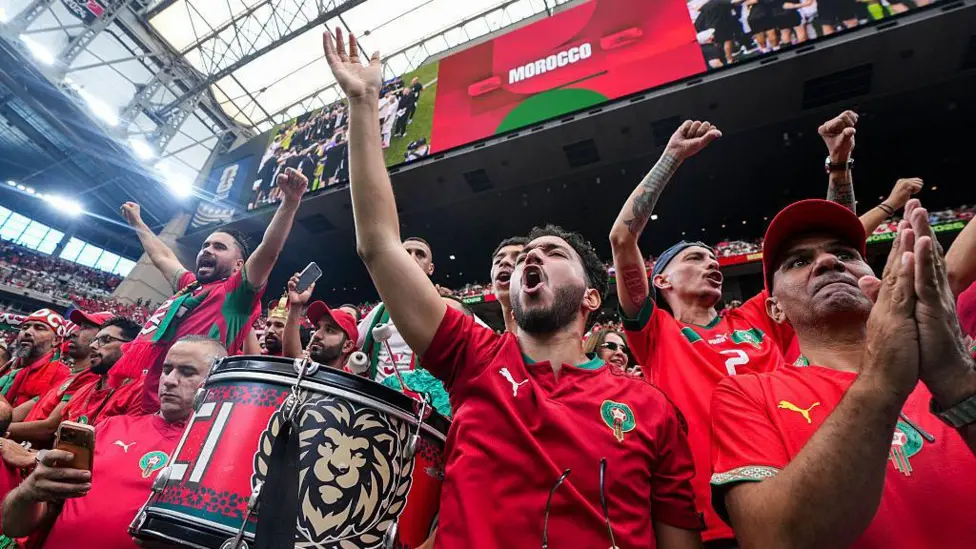
Thursday’s quarter‑final between France and Morocco is more than just another World Cup clash. For many Moroccan supporters, it represents unfinished business.
Four years ago in Qatar, France ended Morocco’s historic run, eliminating the first African and Arab nation ever to reach a World Cup semi‑final. This time, the Atlas Lions return not as dreamers, but as contenders who believe they belong among football’s elite.
“This is a revenge match for the Moroccan national team,” said sports journalist Hamza Shteiwy. “Especially for the players who were part of that 2022 squad. They felt that loss deeply, and now they’re looking to settle the score — for themselves and for the team.”
From Dreamers to Believers
In Qatar, Morocco’s semi‑final appearance was hailed as miraculous. Today, expectations are higher. “In 2022 we were the dreamers,” Shteiwy noted. “Now people’s expectations are much higher. Anything less than the semi‑finals wouldn’t be considered an achievement.”
That confidence is rooted in progress since 2022. Morocco’s Under‑20 side captured the youth World Cup, the senior team climbed to sixth in FIFA’s rankings, and the Royal Moroccan Football Federation’s long‑term investment in youth development is bearing fruit. “What happened in Qatar wasn’t a fluke,” said veteran journalist Hameed Bel Hassan. “It was the result of years of strategic planning and programmes put in place by the Federation. This has been a national project. We now have a formidable national team.”
Morocco have impressed in this tournament, holding Brazil before defeating Scotland, the Netherlands, and Canada to set up another meeting with France. “There’s deep faith in this team,” Shteiwy said, noting the influx of fans travelling from Morocco and across the diaspora. “I dare say Morocco will have the stronger support.”
France’s Strength
France, however, remain one of the tournament’s most complete sides. With Kylian Mbappé leading a star‑studded squad, Les Bleus have reached the quarter‑finals playing fluid, attacking football. “Individually they’re stronger,” Shteiwy admitted. “But Morocco’s midfield is about equal. If they can press France early, like they did against Brazil, they can create problems. The 11 players just need to perform as one.”
Mothers and Motivation
Morocco’s rise has also been defined by the visible role of players’ mothers. Iconic images from Qatar — Achraf Hakimi embracing his mother, Sofiane Boufal dancing with his — have continued this year, with Ismael Saibari running into the stands to hug his mother after scoring against the Netherlands. RMFF president Fouzi Lekjaa has described their presence as a deliberate psychological support strategy. “When the player sees his mother in the stands, it’s a huge boost and motivation,” Bel Hassan explained. “A mother’s prayer, nothing really comes close.”
A Match Beyond Football
The encounter carries historical weight. France and Morocco share a complex past shaped by colonialism, migration, and one of Europe’s largest Moroccan diasporas. Several Moroccan internationals could have represented France but chose instead the country of their heritage. Hakimi versus Mbappé — club teammates, close friends, and rivals for one night — embodies that narrative.
For Morocco, the question is not only whether they can defeat France, but whether they can prove that Qatar was not the peak of their journey, but the foundation. In Qatar, they made history. In Boston, they aim to show it was only the beginning.
Source: BBC