


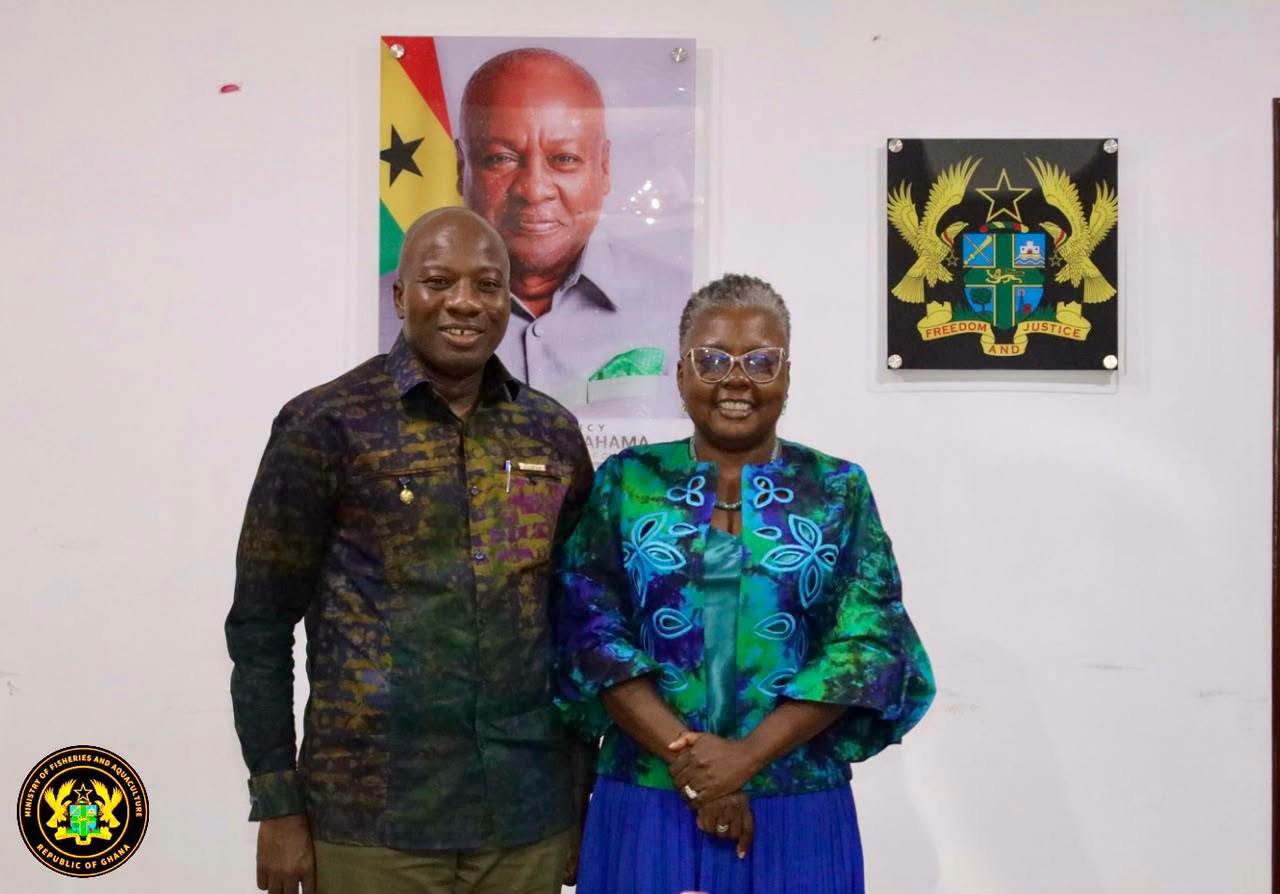
The Ministry of Fisheries and Aquaculture Development and the Ministry of Local Government, Chieftaincy and Religious Affairs have begun discussions on a strategic partnership aimed at expanding aquaculture, increasing domestic fish production, and promoting local economic development across the country.
The collaboration was explored during a high-level meeting between the Minister for Fisheries and Aquaculture Development, Emelia Arthur, and the Minister for Local Government, Chieftaincy and Religious Affairs, Mahama Ayariga.
At the meeting, officials from the Fisheries Ministry presented an overview of the sector’s key activities, achievements and interventions undertaken since 2025, while highlighting areas where closer cooperation between the two ministries could accelerate the growth of fisheries and aquaculture.
Discussions focused on the need to increase local fish production to address Ghana’s estimated annual fish supply deficit of 500,000 metric tonnes. Officials noted that expanding domestic production would help reduce the country’s dependence on imported frozen fish, improve food security, and create sustainable jobs along the fisheries value chain.
Mr. Ayariga stressed the importance of placing fisheries and aquaculture at the centre of local economic development strategies. He proposed the development of a structured framework to support Metropolitan, Municipal and District Assemblies (MMDAs) in identifying viable fisheries-related enterprises, assessing infrastructure and operational needs, and mapping areas with strong aquaculture potential.
According to him, such a framework would facilitate efficient allocation of resources, attract private sector investment, and boost internally generated revenue for local authorities.
For her part, Ms. Arthur underscored the need to strengthen domestic fish production and enhance governance in the sector. She called for the documentation and integration of indigenous knowledge into fisheries management through local bylaws and emphasized the need to formally recognize the contributions of artisanal and local fishers.
The Fisheries Minister also highlighted the importance of regional aquaculture mapping as a means of identifying investment opportunities, particularly in inland fish farming.
She expressed optimism that the partnership between the two ministries would help transform the fisheries sector, narrow the country’s fish supply gap, and improve livelihoods in fishing communities and beyond.
The engagement forms part of broader efforts by both ministries to deepen institutional collaboration, attract strategic investments, and position fisheries and aquaculture as key drivers of local economic growth, food security and job creation in Ghana.