


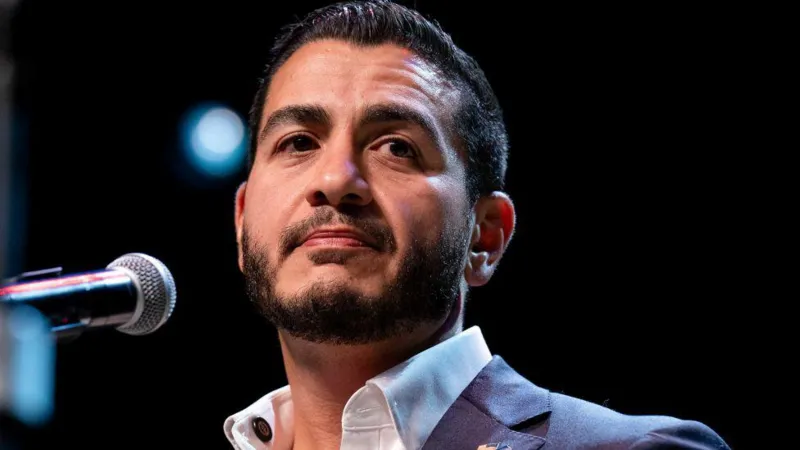
The tremors from Abdul El-Sayed’s victory in Michigan’s Senate primary will have been felt hundreds of miles away by the Democratic Party leadership.
In a year in which Republicans appear to be facing significant electoral headwinds, Democratic primary voters have taken a chance on a left-wing insurgent, raising the stakes in a Senate race in November that could decide overall control of the upper chamber.
The question is whether the way El-Sayed has electrified the party base and tapped into their anger will work on general election voters. And whether an unabashedly left-wing Democrat can win in a swing state.
The party establishment, which had backed his opponent, will hope so.
Primary results across five states on Tuesday were a snapshot of the mood of the American electorate three months before the midterm elections.
Here are four key takeaways from the results.
1) A new left-wing warrior
Abdul El-Sayed’s victory on Tuesday night in Michigan’s contentious Democratic primary race for Senate was hardly a surprise. He had led by a comfortable margin over Congresswoman Haley Stevens for weeks.
While the final projected result was much closer than those surveys had suggested, again raising questions about modern polling accuracy, it doesn’t diminish the shockwaves the victory of the former Michigan health official is sending throughout the Democratic Party.
El-Sayed, the child of Egyptian immigrants, ran on a left-wing platform with the backing of such liberal stalwarts as Senators Bernie Sanders and Elizabeth Warren and Congresswoman Alexandria Ocasio-Cortez.
Stevens had the backing of Democratic leadership in Washington, an established record as an elected official in Michigan and deep financial pockets, including $32m from Aipac -the American Israel Public Affairs Committee. Outside groups favoured her over El-Sayed by a margin of nine-to-one.
None of it mattered.
In debates and on the stump, El-Sayed proved to be the more gifted candidate, and Democrats seemed open to his policies, including government-sponsored health insurance, efforts to lower drug costs, higher taxes on the wealthy and campaign finance reform.
Leave a Reply