


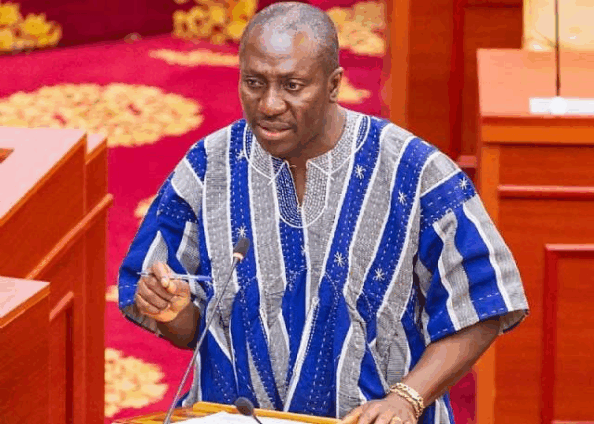
Minority Leader and Member of Parliament for Effutu, Alexander Afenyo-Markin, has cautioned that Ghana risks being left behind in the global technological race if the government continues to prioritise political score-settling over long-term national development.
In a follow-up section of his statement on the state of Ghana’s democracy, Mr. Afenyo-Markin said the world has entered an era defined by artificial intelligence and rapid technological innovation, warning that “the world is not waiting for us.”
He said leading global powers, including the United States, China, the United Arab Emirates and Saudi Arabia, are making massive investments in AI, digital infrastructure and human capital as part of preparations for the Fourth Industrial Revolution, while Ghana risks lagging behind.
According to him, the application of artificial intelligence is already transforming agriculture, healthcare, education, security and manufacturing in advanced economies, making urgent the need for Ghana to invest in digital skills, research capacity and innovation-driven education.
He challenged President John Dramani Mahama to outline clear plans for positioning Ghana’s youth to compete in the global digital economy, arguing that job creation and economic transformation in the future will depend heavily on technology.
Mr. Afenyo-Markin again criticised what he described as a government preoccupation with removing constitutional office holders and arresting political opponents, saying such a focus undermines the building of a knowledge-based and technology-driven economy.
He urged President Mahama to “put his foot down” and resist what he termed the influence of “hawks” within government, whom he accused of pushing an agenda of retribution rather than development.
The Minority Leader warned that Ghana’s parliamentary majority and public goodwill were not unlimited and could be eroded if governance priorities remain misplaced.
He also raised concerns about growing global and regional instability, pointing to protests across continents and recent democratic setbacks in parts of West Africa. While condemning military takeovers, he warned that public frustration with poor governance can make populations vulnerable to undemocratic alternatives.
He concluded by calling on political leaders to respect constitutionalism, focus on economic transformation and restore public confidence in democratic governance, stressing that Ghana’s future depends not on political vengeance but on innovation, opportunity and inclusive national development.
Leave a Reply