


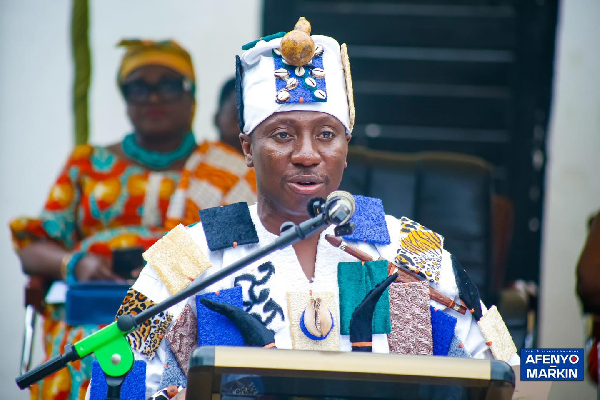
Minority Leader and Member of Parliament for Effutu, Alexander Afenyo-Markin, has cautioned that Ghana’s democracy is only as strong as the institutions and citizens who defend it, warning that hard-won gains could be reversed if complacency sets in.
In the final section of his address on the state of the nation one year after the change of government, Mr. Afenyo-Markin described democracy as an “imperfect miracle” that remains humanity’s best system of governance because it allows peaceful self-correction through the ballot box and independent institutions.
He warned that recent developments, particularly threats to the independence of democratic oversight bodies, could undermine the very mechanisms that allow citizens to hold leaders accountable.
On the economy, the Minority Leader expressed concern about what he termed an “artificial” stabilisation of the cedi, arguing that currency stability driven by central bank forex injections rather than increased production and exports is unsustainable. He said without real industrial growth, expanded manufacturing and export capacity, economic gains would remain fragile.
He also drew attention to the plight of young people, accusing political leaders across party lines of using youth as campaign foot soldiers and abandoning them after elections. According to him, persistent unemployment and marginalisation among politically active youth pose serious long-term risks to national stability.
Mr. Afenyo-Markin further turned the spotlight on his own party, the New Patriotic Party (NPP), admitting that arrogance, detachment and poor governance while in office contributed to the party’s electoral defeat, and described the problem as a bipartisan failure.
He challenged the media to live up to its constitutional role as watchdog, urging journalists to prioritise truth and accountability over access and silence, warning that a quiet press in the face of constitutional violations becomes complicit.
Despite his criticisms, Mr. Afenyo-Markin insisted that the Minority does not wish for the government’s failure, stating that a responsible opposition works for national success by offering constructive criticism and alternative ideas.
He concluded with an appeal to President John Dramani Mahama and political leaders to focus on legacy-building through development rather than retribution, urging the youth to keep faith in democratic change through the ballot box.
He emphasised that Ghana’s democracy, though slow and imperfect, remains the nation’s surest path to renewal, warning that the people who spoke at the polls once can speak again.
Leave a Reply