


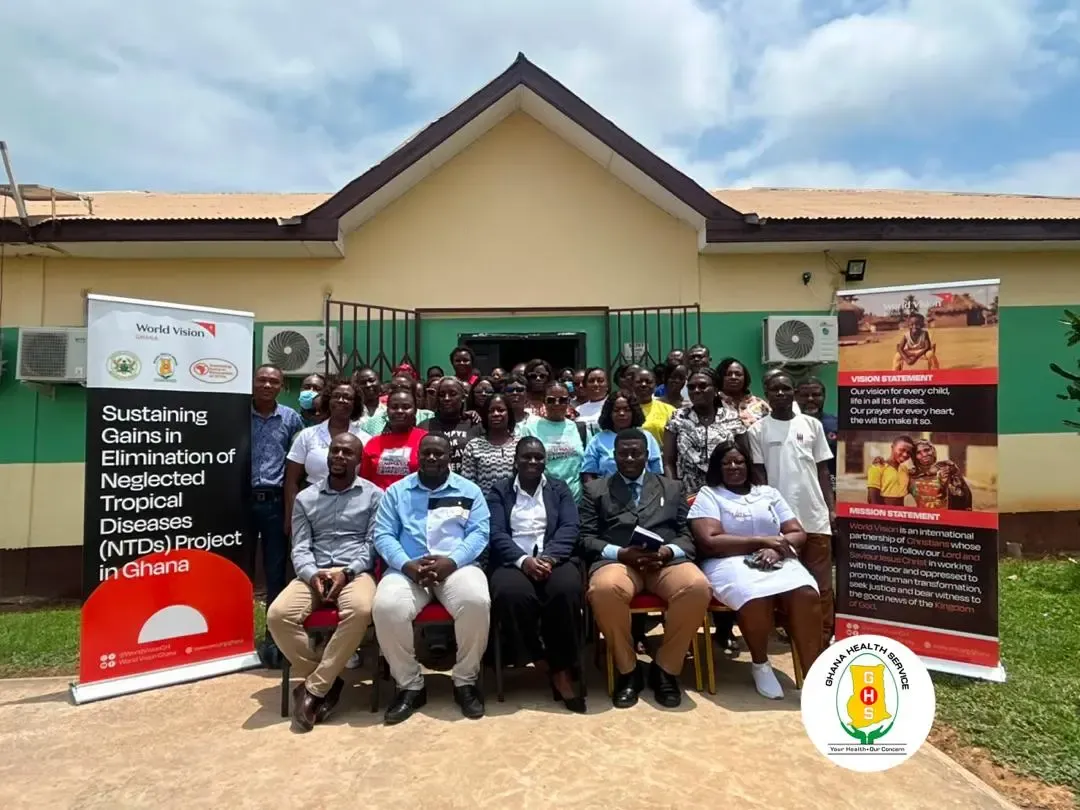
The Ghana Health Service (GHS), in partnership with World Vision Ghana, has organised a capacity-building training programme for Community Health Officers and frontline nurses aimed at improving the early detection, referral and management of Neglected Tropical Diseases (NTDs) across the country.
Speaking at the training held at the Bortianor Polyclinic in the Greater Accra Region, the Programme Manager for NTDs at the GHS, Dr Joseph Kwadwo Larbi Opare, emphasised the critical role frontline health workers play in reaching affected individuals in rural, peri-urban and underserved communities.
He said embedding basic NTD identification into routine household visits was a key operational step towards achieving this goal.
Dr Opare explained that frontline staff were being trained to recognise key physical indicators of NTDs, including persistent skin rashes, body part enlargements, deep or chronic ulcers, blood in urine, and visual impairments.
He said during standard door-to-door home visits, community health nurses would use simplified screening questions to identify suspected cases and refer patients directly to health facilities for medical evaluation, a move he said would help eliminate the social stigma, disfigurement and isolation associated with the conditions.
According to him, the project is currently training about 300 frontline health workers across three target districts — Ga South, Kpandai North and Kassena Nankana West. He added that case identification and tracking were being digitised via tablets using an expanded composite register, to streamline reporting and reduce paperwork, establishing a structured model intended for eventual nationwide rollout.
Dr Opare further noted that the NTD initiative aligned directly with the Government’s Universal Health Coverage (UHC) agenda, and urged health personnel to actively facilitate National Health Insurance Scheme (NHIS) enrolment for indigent patients to ensure they could access free, continuous medical care and financial protection.
In her remarks, the Health and Nutrition Technical Programme Specialist at World Vision, Awurabena Quayeba Dadzie, outlined the core mission and strategic objectives of integrating NTD management into primary healthcare.
She said the primary goal was to strengthen the capacity of Community Health Officers, supervisors and district stakeholders to effectively utilise the primary healthcare e-tracker, an initiative aimed at enhancing NTD counselling, health education, case identification, management, referral, surveillance and linkage to NHIS services.
Reflecting on lessons from the initial pilot in districts such as Mfantseman and Gomoa West, she cited key milestones, including 1,917 households visited, 1,117 suspected cases identified, and 172 individuals with severe symptoms and stigma screened and managed.
She said through updated primary healthcare e-tracker platforms, enhanced community-level screening and streamlined referral tracking, the initiative sought to integrate NTD surveillance seamlessly into routine health visits rather than treat it as a standalone task.
Touching on the vital connection between health and social welfare, Mrs Dadzie underscored the need for multi-sectoral collaboration with agencies such as the NHIS and Social Welfare to ensure vulnerable patients received long-term, cost-free care through indigence registration.
She noted that building on the foundation laid by the Ministry of Health and GHS leadership, together with local district directors, the current training of 272 health personnel across multiple sub-districts marked a crucial step towards scaling the integrated health solutions region-wide and ultimately eradicating NTDs.
Leave a Reply